

- This event has passed.
U.S. Government Assessments of Nuclear War and Nuclear Terrorism Risks: Findings of a National Academies Study
 Abstract
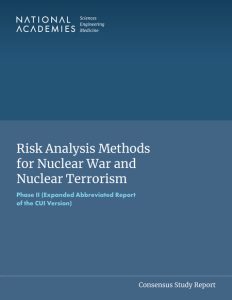
A recent congressionally-mandated study by the National Academies of Sciences, Engineering, and Medicine examined U.S. government methods for assessing nuclear war and nuclear terrorism risks, how those assessments are used to develop strategy and policy, and their limitations and gaps. In this webinar, the co-chairs and director of this National Academies study will discuss how US nuclear war and terrorism assessments are generated and some findings and key recommendations. These include a need for the methods used to create nuclear war risk analyses to consider a broader scope of pathways and outcomes, and possible weaknesses in how U.S. Strategic Command generates its daily “Risk of Strategic Deterrence Failure” assessment for each nuclear-armed adversary. The findings also highlight the need for the current limited assessments of the consequences of nuclear explosions resulting from strategic deterrence failure to include other physical and environmental effects of nuclear weapons, as well as psychological, societal, and political consequences of nuclear weapons use.
The report is available for free download at: https://nap.nationalacademies.org/catalog/27745/risk-analysis-methods-for-nuclear-war-and-nuclear-terrorism-phase
Speakers:
- Dr. Jenny Heimberg, Study Director of the Committee on Risk Analysis Methods for Nuclear War and Nuclear Terrorism, and Acting Director of the Committee on International Security and Arms Control, National Academies of Sciences, Engineering, and Medicine.
- William C. Ostendorff, Co-Chair of the Committee on Risk Analysis Methods for Nuclear War and Nuclear Terrorism, and former Principal Deputy Administrator of the US National Nuclear Security Administration
- Dr. M. Élisabeth Paté-Cornell, Co-Chair of the Committee on Risk Analysis Methods for Nuclear War and Nuclear Terrorism, and Professor in the Department of Management Science and Engineering, Stanford University
Speakers’ full biographies:
Dr. Jennifer (Jenny) Heimberg has worked at the National Academies of Sciences, Engineering, and Medicine since 2011. She is currently the acting director for the Committee on International Security and Arms Control (CISAC). Most recently, she was the inaugural director for the Strategic Council for Research Excellence, Integrity, and Trust, an effort initiated and led by the President of the National Academy of Sciences. In addition, she has directed studies related to nuclear risks, nuclear security, nonproliferation, and nuclear environmental cleanup. Other topics include reproducibility and replicability in science (Reproducibility and Replicability in Science, 2019) and estimating the costs of climate damages (Valuing Climate Damages: Updating the Estimation of the Social Cost of Carbon Dioxide, 2017). Prior to coming to the National Academies, she worked as a program manager at the Johns Hopkins University Applied Physics Laboratory (JHUAPL). She received a BS in physics from Georgetown University, a BSEE from Catholic University of America, and a PhD in physics from Northwestern University.
Dr. M.-Elisabeth Paté-Cornell is the Burt and Deedee McMurtry Professor of Management Science and Engineering at Stanford, a Courtesy Professor of the Stanford Department of Aero-Astro, and a Senior Fellow (by courtesy) of the Stanford Freeman-Spogli Institute for International Studies. Her specialty is engineering risk analysis, with applications to complex systems (space, medical, offshore oil platforms, cyber security, etc.). Her work has been based on probabilistic and stochastic models, and on Artificial Intelligence. She has been a member of the Army Science Board, of the Air Force Science Board and of the Board of the Navy Post-Graduate School, which she chaired. She is a member of the National Academy of Engineering, the French Académie des Technologies, and the NASA Advisory Council. She was a member of the President’s Foreign Intelligence Advisory Board (2001 to 2008). She holds a BS in Mathematics and Physics in Marseille (France), an Engineering degree (Applied Math/CS) from the Institut Polytechnique de Grenoble (France), and from Stanford University an MS in Operations Research (OR) and a PhD in Engineering-Economic Systems (EES). She is the author or coauthor of more than a hundred publications including several Best Paper awards. From the Society for Risk Analysis (of which she is a Fellow and past President) she was awarded the 2002 Distinguished Achievement Award and the 2025 Distinguished Educator Award. She received the Ramsey Medal of Decision Analysis from INFORMS in 2010, an Honorary PhD from the University of Strathclyde, Scotland, in 2016, and the IEEE Ramo medal for Systems Engineering and Science in 2021.
Bill Ostendorff currently serves on the board of directors of Sandia National Laboratory, Global Laser Enrichment and Cavendish Nuclear USA. He also serves on INPO’s Advisory Council and chairs the Decommissioning Nuclear Safety Review Board for Three Mile Island Unit 2. From 2016-2021, he served as the Class of 1960 Distinguished Visiting Professor in National Security at the US Naval Academy. Mr. Ostendorff has been confirmed by the U.S. Senate on three occasions in both Republican and Democratic administrations. He served as Principal Deputy Administrator at the National Nuclear Security Administration (NNSA) in the Bush administration (2007-2009) and as a Commissioner at the US Nuclear Regulatory Commission (2010-2016) in the Obama administration prior to joining the Naval Academy faculty. From 2003 to 2007, he served as counsel and staff director for the Strategic Forces Subcommittee with oversight responsibilities for the Department of Energy’s Atomic Energy Defense Activities as well as the Department of Defense’s space, missile defense and intelligence programs. Mr. Ostendorff was an officer in the United States Navy from 1976 until he retired in 2002 with the rank of captain. Entering the Rickover Nuclear Navy, he served on six submarines. During his naval career, he commanded a nuclear attack submarine and a nuclear attack submarine squadron. Mr. Ostendorff earned a bachelor’s degree in systems engineering from the United States Naval Academy and law degrees from the University of Texas and Georgetown University. He is the recipient of the US Nuclear Industry Council’s Lifetime Achievement Award and the American Nuclear Society’s Eisenhower Award.